Under pressure our thinking narrows. Whether it has to is another question.
Strait Living
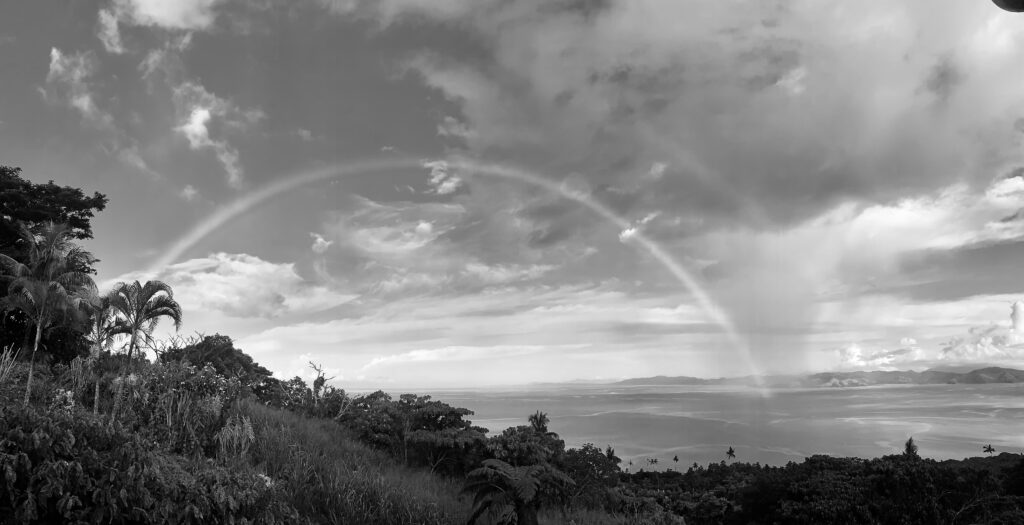
As I write this, I am in a position of vantage. The Somosomo Strait lies below. The air is still. The water flat. More lake than restless ocean. A rainbow arcs from land to sea after a morning shower.
The Somosomo Strait is not a major passage for commerce or commercial goods beyond the staples for island living. Yet is holds and is home to the Rainbow Reef, a vast coral system drawing in a wide diversity of ocean life.
Earlier, two dive boats crossed toward the Reef, their wakes brief white partings in the blue. Divers come from far away. Some to take pictures. Some to tick places or creatures off a list. Some simply for the beauty of being below the surface. All sense its fragility.
The Rainbow, as with reefs everywhere is under stress. Yesterday with visiting friends we crossed the Strait to dive. We saw colour and brightness – coral and fish – and stretches of grey bleached and coral sea bed. The water summer-warm. Almost hot.
The Somosomo Strait lies between the Fiji islands of Taveuni and Vanua Levu. It is not large but it is decisive- resolving open water into direction. Here the Pacific is drawn through a tighter passage. That compression shapes weather, currents and daily life along its shores and in its depths.
Today though the talk among the locals was of diesel – when it might run out. Far away in another strait more famous and more troubled word had reached us: the island is forty days from running dry of fuel. About the time it takes a laden tanker to reach us. So we lined up, rationally enough, to fill tanks. Our truck. The backup generator. And wait.
Fiji is one of many – caught between events far beyond its shore.
Somosomo. Hormuz.
Two straits, alike in their determining – narrowing what enters, deciding what flows.
Straits are barriers in the natural world and magnets to human aspirations. What a tale these straits tell. Not just of geography. But of how we think.
From my vantage point I see a strait as a geological fact, a narrowing between two pieces of land. Its position set by geography long before my witness. Its importance is consequential. Straits divide as much as they connect. The currents here feel the special joys of the white wall of the Rainbow Reef.
The Somosomo is one of many lesser known passages, often not entering the language of security or honour. There is little here it seems to acquire. And so they pass mostly unnoticed – until something begins to run thin.
Historically we have fought over geographic straits where trade, power and ambition are forced through tight passages. The instinct is always the same: control the channel, dominant the flow, survive the pressure.
Pressures arrive along familiar lines – work and money, politics and identity, duty and desire. We feel them as forces pushing against each other. A sense that there is no room to turn without consequence.
We respond in kind. Push. Adjust. Negotiate. Endure.
Life flattens. Options narrow.
In these moments, life becomes a strait.
There are real constraints in the world. Channels are narrow. Reefs are fragile. Decisions carry weight. Not all pressure is illusion as not all boundaries can be transcended. Some must be navigated with care.
But others we internalize. We take the narrowness of the passage and stich it into a straightjacket. We begin to believe that the limits we feel are the only limits that exist. We may not even play straight with ourselves.
There is a discipline in that recognition. A kind of honesty. To see the narrowing clearly without dramatizing it and without denying it. Not every passage can be widened. Not every pressure can be negotiated away.
And yet something curious happens under compression. Forces applied in one direction often produce their most meaningful effects at right angles. Not as direct outcomes but as side effects – quiet, unexpected, and often more consequential than the original intention.
Strait living isn’t about purity.
It is about not pretending the passage is wide or a frontier when it isn’t. Solutions to compression do not arrive by pushing along the same line, they appear … elsewhere.
We struggle to see this because we are comfortable in two dimensions. We optimize within the plane. We rarely question whether the plane itself is the limitation. So when pressure builds along the X and Y of our lives, we look for relief along those same axis. More effort. Better tactics. Stronger arguments.
Though the way through is not in the plane at all.
It is in the Z.
A shift in dimension. Not more effort – a shift in plane, of vantage. This is the quiet invitation hidden inside every strait.
Strait living is not simply enduring narrow passages.
It is learning to recognize when the passage is real and when the narrowness is of our own thinking. It is knowing when to steer carefully within the channel and when to lift our gaze and ask whether another dimension is available.
The ocean offers a lesson here.
On the surface currents appear to move in lines. But beneath they layer, fold, and turn. Temperature, salinity and depth create movements that cannot be understood from above alone. What looks like constraint at one level becomes flow at another.
The ocean does not live in two dimensions.
Neither ultimately do we.
The strait may be narrow. The forces may be real. But the way through is not always where we are looking.
Sometimes it waits just beyond the edge of the plane.
To stand above a strait is a kind of privilege. Not because it grants power – but it removes the illusion. And leaves you with the simple work: not pretending the passage is wide when it isn’t.
A quiet noticing of what is always there, if we look.